


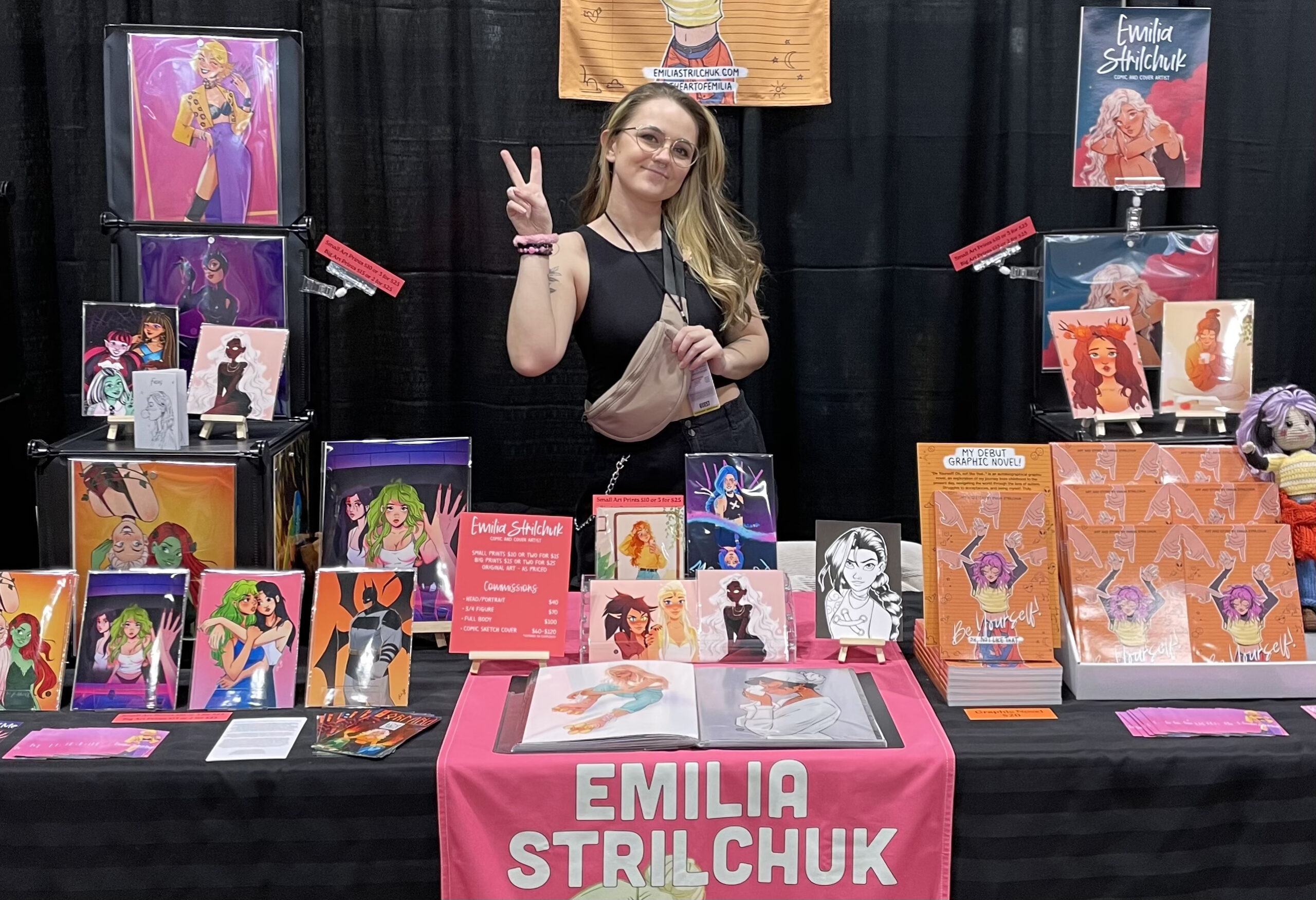
From deeply personal stories to fantastical, otherworldly tales, writer and comic artist Emilia Strilchuk is drawn to stories that explore themes of mental health, neurodiversity and resilience.
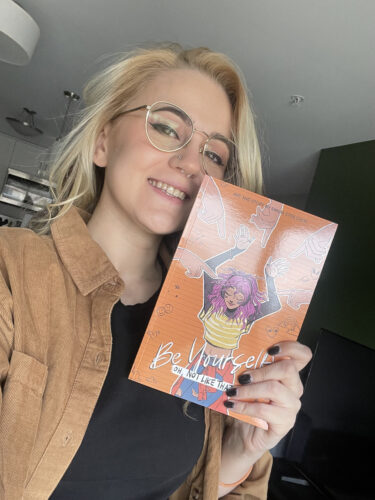
In 2024, Strilchuk self-published an autobiographical graphic novel titled Be Yourself! Oh, not like that—sharing her journey growing up undiagnosed autistic, struggling to fit into society’s moulds, and finally receiving her diagnosis at age 28. The book began with a Kickstarter campaign and was met with a warm response from readers who felt seen by Strilchuk’s experiences, and went on to receive nominations for a Doug Wright Award and a Zelda Award.
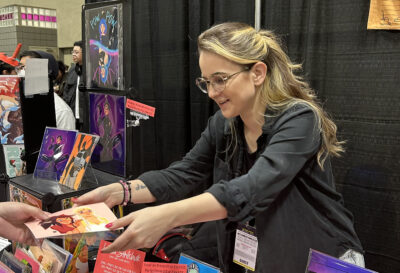
This weekend (March 20-22), Strilchuk will be showcasing their work at Toronto Comicon’s Artist Alley. Ahead of the convention, we asked her to share her advice for neurodivergent creators, her approach to visual storytelling, and what we can expect from her two upcoming books: Oriana: The Forgotten Deities, and A Little Unsteady: A Journey With POTS.
Last year was your first year as a guest at Toronto Comicon! What was that experience like for you? What are you looking forward to this year?
Last year was pretty significant to me, because I lived in Toronto for a while, and then last year was the first time I was a guest at the convention. The year before that, I attended for the first time and was talking to fellow creators and comic artists, and asking what to do, where to start. So being a guest last year…that was really amazing. And this will be my second year as a guest, and I hope to do the same for artists and creators that are starting out. I love answering questions that people may have.
View this post on Instagram
What first drew you towards the world of comic creation?
I didn’t grow up with comics like a lot of people grew up here. I grew up in Ukraine, we didn’t really have a lot of superhero comics, or any comics, really. I always did some type of art, and I read a lot of manga when I was a teenager. And then when I moved to Canada, I got into comics more. I always wanted to tell stories, I always wanted to write, but it didn’t click until much later in life that I write and I draw and that’s a medium—that’s what comics and graphic novels are. So it was very random. One day it was like, “Oh my god. Like, that’s what comics are.”
As both a writer and a visual artist, how would you describe your approach to graphic novels?
I think it’s different for different stories. So my book Be Yourself! Oh, not like that is an autobiographical graphic novel. It’s about me getting diagnosed autistic at 28 and it talks about my life and sort of what led to it. So that was a story I really wanted to tell, and that was the story first. Then the visuals came after, because I needed to put the story in pictures.
I’m doing another story, Oriana: The Forgotten Deities, that’s a Slavic mythology retelling. I like reading mythology, and I was just sketching characters. Just by sketching the characters out, I was like, okay, these are the characters that I can put in a story. A lot of visuals for that, and the ideas and setting came first, and then I started brainstorming the story for all of the possible different characters that can be in it.
Speaking of your book, Be Yourself! Oh, not like that, what was it like for you to tell your story and write about some really challenging times in your life?
I was at a dark place in life multiple times, and a lot of it had to do with me not knowing that I was autistic. A lot of people in my life, like friends in the past or family members, didn’t get a lot of things. There were a lot of things that I had to repeat constantly and try to explain. But it was also very exhausting to have to give so much background to explain that perspective, and give so much context. So writing the book was easier in a way, because I’ve already said those things so many times. I went back to those experiences in life so many times too. So it felt almost like I was talking to those people and just putting all of it on paper, as well as a letter to myself and to my younger self, talking to someone who’s younger, who’s going through the same things that I was going through.
A lot of readers can see themselves in your experiences. What has it been like to see the response to the book, and also have it nominated for two awards?
I didn’t expect it. I self-published it, and I had a Kickstarter for it with a very low goal, because I just wanted to print a few copies to maybe go to a convention, or give to friends and family, but it was very successful. When I started getting the first responses from the backers who received the book first, they saw themselves in it. Some were much, much older than me. Some were younger, and it was validating for them be like, “Oh my God. No one gets that.” So for people to see that others have that experience as well…that’s more than I wanted. If it could help one person see themselves in it, that would be great. But now, so many more people do.
That speaks to the fact that we need more representation when it comes to neurodiverse stories. Do you have any advice for any other neurodiverse creators who want to tell their story?
Just tell it. Because if someone knows one autistic person, they just know that one autistic person. There’s a lot of experiences that overlap, but everyone’s life and experiences are different based on where they grew up, their race, socioeconomic status. There’s so much that goes into the experience, especially being neurodivergent. So if you have a story and you want to tell it, it’s very freeing. It’s very scary too. Writing autobiographical stories is important and is very freeing. Autobiographical stories helped me see that people struggle with so many different things, and we don’t know. And if someone can do that in a visual graphic novel or comic medium for a neurodiverse population, it is also very great to see someone showing what they’re going through on the inside visually.
You mentioned autobiographical stories. What other kinds of stories do you find yourself drawn to most?
I like stories that, even if it’s fantasy fiction, touch on mental health. I love a lot of young adult stories, because they’re fun, but talk about important topics. They talk about relationships, friendships, politics, in a very accessible way, often fictionalized, but it’s just very approachable, and I really like that in them.
Oriana: The Forgotten Deities is coming out soon. What else can you tell us about it?
Without too many spoilers… in June, it will be the first part, and there will be five chapters to it. It’s a retelling of Slavic mythology set in the modern world. There’s not a lot of connected lore, for example, like Greek mythology does, and each country has slightly different stories. So there’s a lot of freedom for me to write it. And it’s all fictionalized.
Are there any other upcoming projects you can tell us about?
Last year, I received a grant from the Ontario Arts Council to work on a book called A Little Unsteady, and it talks about me having POTS (Postural Orthostatic Tachycardia Syndrome). It’s semi-autobiographical. I wanted to include experiences of people with invisible disabilities. Since I was a pre-teen, I was fainting a lot. I have a lot of brain fog. There’s a lot of symptoms that come with it [POTS], and it’s not visible. A lot of medical professionals don’t see what you talk about, and that’s why it’s so difficult to get diagnosed. So, another semi-autobiographical story. That will be sometime in 2027 so I’m currently slowly working on it.
Is there something that you wish more people knew about the job of being a comic creator?
It’s very fun, but it’s very hard as well. People often want to do projects or finish an art piece very quickly. And with comics, it’s like, “Oh, I have an idea for a book. You’ll see it in three to four years.” It takes so long. So if someone is interested in starting out or getting into comics, I would suggest starting with 8-page, 16-page stories and then going from there. But it’s very fun once you get into it. And read a lot of comics!
See Emilia Strilchuk at Table P153 at Toronto Comicon from March 20-22. See here for tickets and more information.
Responses have been edited for length and clarity.
 Follow Us On Instagram