




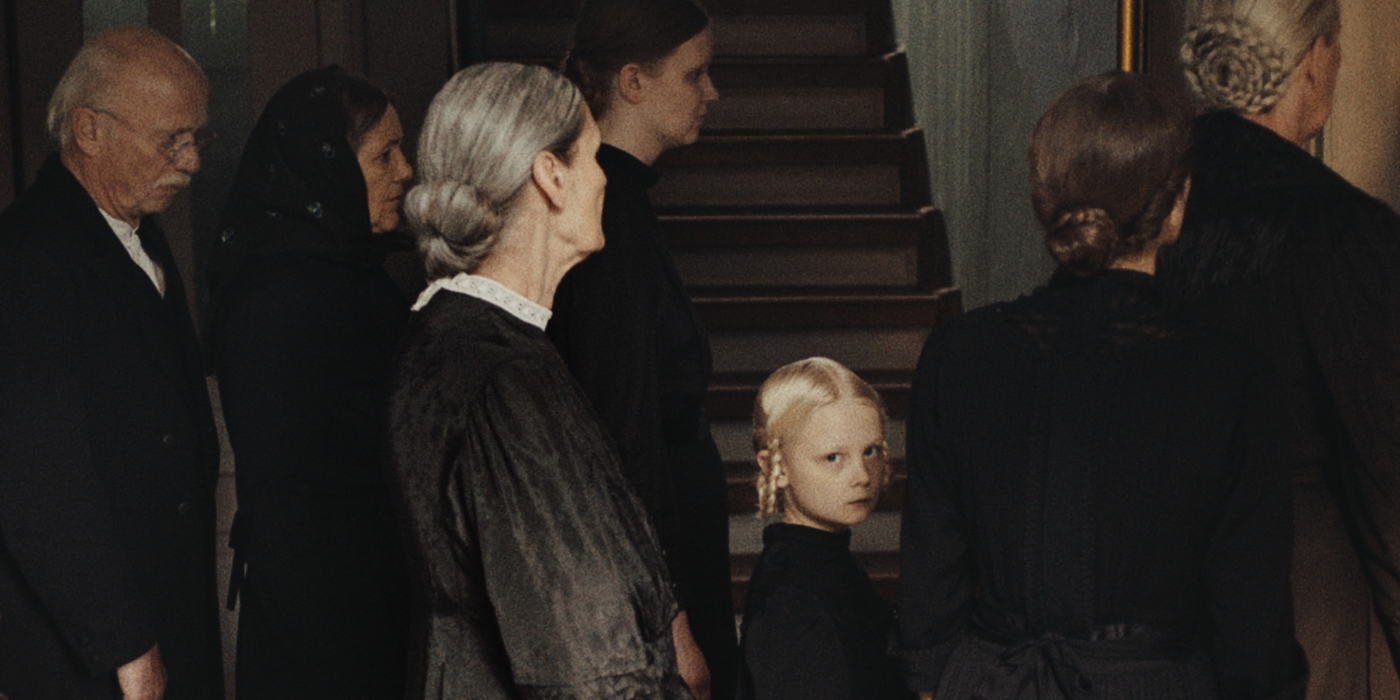
Mascha Schilinski’s Sound of Falling does what few titles can: depict how trauma can span generations. Premiering in select theatres on January 23, the film was first shown at last year’s Cannes Film Festival, winning the prestigious Jury Prize and garnering rave reviews. It was even shortlisted for an Oscar in the Best International Feature category. Sound of Falling’s recognition goes to show that multigenerational stories can offer a mirror to our society, proving that women are still endangered and suppressed despite the passing of time.
The idea for Schilinski’s sophomore film stemmed from several conversations she had with her co-writer, Louise Peter, about what is written in our bodies through time and what determines who we will become even before we are born. “We collected tiny stories about transgenerational trauma, but we didn’t know how to turn it into a film, because everything I was interested in was invisible,” Schilinski says.
It was only after she and Peter escaped to the countryside during the pandemic that the concept for Sound of Falling became more defined. They were fascinated by a house that they visited that had been vacant for over 50 years. After finding snapshots of maids in the ‘20s, posing in front of that same house, the director was surprised to notice that little had changed about the estate’s appearance. She began to wonder about all of the untold stories that could’ve come out of that place.
Their research and imaginative input led to the journeys of the four women at the heart of this German film. Sound of Falling follows Alma (Hanna Heckt), a child trying to make sense of the odd events around her growing up in a rigorous cult during the Great War, Erika (Lea Drinda), a young woman who is fascinated by her bedridden amputee uncle and often rebelling against her parents in the ‘40s, Angelika (Lena Urzendowsky), a girl experiencing a sexual awakening of sorts in the ‘80s, and Lenka (Laeni Geiseler), a girl in the present day timeline who becomes obsessed with imitating her best friend.
Seemingly disconnected, these women’s experiences slowly overlap as they live on the same farm throughout a century. Told out of chronological order, Schilinski invites audiences to actively observe the parallels, with only sounds and camera movements guiding them from one character’s point of view to the next.
“For me, the film is about memory itself and how memory and imagination flow into each other,” the director says. “I wanted to create more of a physical experience than a classical narrative, because memory itself is not linear. It’s not like storytelling. It jumps from time to time.”
Alma is the youngest of the central characters, and her innocence sadly fades away. With death lurking at every corner, she slowly pieces together the violence around her with small glimpses through keyholes and cracks in the wall, as she begins to understand that she doesn’t have any control of her own destiny. To Schilinski, despite Alma’s age, she is still able to grasp the brutal reality she’s in.
“The interesting thing about working with young kids is that they are so smart and they can immediately feel something is wrong or right,” Schilinski says. “They have this ability to feel almost in a hallucinative way the things that adults want to hide. Many concepts and norms that we adhere to are basically human-created, so they’re not given. And children can see that.”
Alma’s realization echoes through the other characters’ experiences. For instance, Angelika is discovering what it means to be desired and what her own fantasies may be. Yet, after being abused by a relative, she begins to behave recklessly and suffers from a tragic fate.
Each of these women are connected, even though they themselves aren’t aware of it. Much like we aren’t fully certain of what happened to our ancestors or relatives in their youth, the film suggests that there might be common threads that are passed on to us—cycles that repeat from one generation to the next.

“We were fascinated, Lisa and I, by the fact that we all have these repetitions in our own lives. We think we’re over it, and then it starts again. Sometimes one lifetime is not enough to solve or to overcome certain things,” she says.
With an ambitious filmmaking approach and a story told through nonlinear events, Sound of Falling isn’t meant to be seen passively. It challenges viewers to sit down, draw conclusions, and reflect beyond the film’s screentime. Schlinski’s direction is about showing as opposed to telling, and although her approach to this story might seem more poetic than structured, she trusts her audience. Through disjointed memories, hazy images, and streams of consciousness, she wants everyone to see past the details and make sense of the stories we carry.
 Follow Us On Instagram