



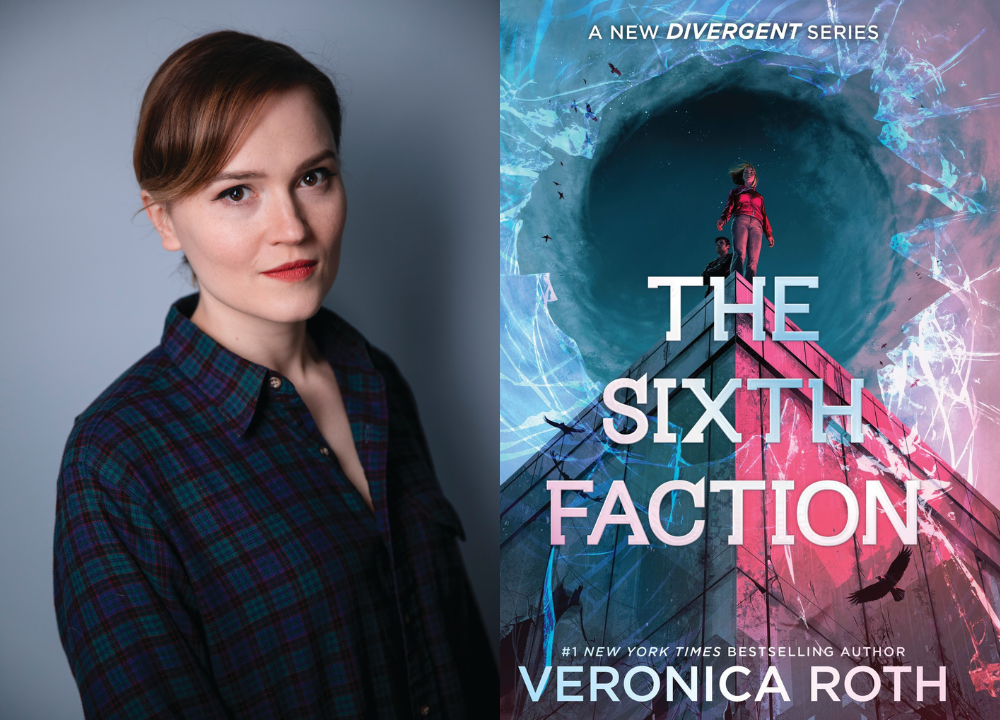
Veronica Roth is the #1 New York Times bestselling author of several novels, including When Among Crows, Seek the Traitor’s Son, Poster Girl, Chosen Ones, the Carve the Mark duology, as well as the global hit Divergent series, which was turned into a major motion picture film franchise. Her latest book, The Sixth Faction, revisits the world of her hit Divergent series. Set in a dystopian society that divides itself into separate factions, 16-year-olds are forced to choose one faction in a decision that shapes the rest of their lives. Everyone is supposed to fit into a specific mould. But what if you can’t?
Presenting an alternate universe where Beatrice (Tris) Prior chooses a different faction and changes her fate entirely, The Sixth Faction is a fast-paced, action-packed book with much to love. The romance is toe-curling. The characters are compelling. If you read the original Divergent series, there is plenty to feed your nostalgia, and if you haven’t read it, you’re introduced to a brand-new breathtaking story. But most of all, you’ll find yourself drawn to our heroine Tris. A young person, shaped by the world around her, but refusing to be defined by it. The Sixth Faction is out now, and the final book in the duology, The Last Testimony, releases in February 2027.
As someone who was a young adult when the Divergent series was first published, I was the prime demographic for the story, and devoured the books and then the movies voraciously. Although I’ve read other books by Roth since the Divergent series, I was thrilled to hear that she was revisiting this world—and jumped at the chance to ask her a few questions.
SheDoesTheCity (SDTC): You wrote your first novel Divergent as a student in university, and now you’re revisiting that world again, 15 years and several bestselling books later. How do you feel you’ve changed as a writer from Divergent to The Sixth Faction?
Veronica Roth (VR): There are five novels and three novellas separating the Divergent series from The Sixth Faction, so as you might imagine, I’ve grown a lot as a writer since then! I think I’ve just built myself a much bigger toolbox as a writer—better at planning, at building intricate worlds, at developing complex relationships between characters, at restraining my prose. Those are just things you learn over time, through effort and experience. But I also feel more comfortable with the writer I am now: fast, but an eager and capable reviser, with prose that’s more sparse than poetic; someone who values intimate stories more than broad, complex ones. I’m leaning into what I am instead of fighting to become someone else.
View this post on Instagram
SDTC: Tris is such a compelling character — at her core, she’s fierce and passionate about justice, but in this book, she’s faced with some tough choices, some that upend the reader’s expectations. Why were you drawn to revisiting her?
VR: With The Sixth Faction, my goal was very personal: I wanted to teach myself to set some of my Divergent baggage down and rediscover my appreciation for the series and the characters. So this book began as a bit of a therapeutic exercise. But it was a pleasure to find Tris’ voice in my head again. She has a clarity and forthrightness that I find appealing.
SDTC: Why do you think readers are drawn to complex, and even flawed women protagonists?
VR: Whenever I talk about complex and flawed protagonists, I always talk about Die Hard. The opening of Die Hard presents us with a flawed man. He’s nervous about flying, he’s estranged from his wife. Writers often believe that in order to get readers to connect with a character, they have to present goodness and likability, but I don’t think that’s true—in Die Hard, we connect with John McClane immediately, and it’s because of his vulnerabilities, not his strengths. (He’s literally barefoot when the office is attacked by terrorists—how much more vulnerable can you get?) The character’s flaws leave space for us, they feel familiar, they invite us into his life. You can’t fall in love with perfection, because you aren’t perfect. And women characters don’t have to be perfect, either.
SDTC: Normally, for a book like The Sixth Faction, world-building would be a big part of the writing experience, but here you’re revisiting a world you’ve already created. What was it like writing within the confines of a world you’ve already defined? What kind of challenges did it present?
VR: I actually feel like I did build an entire world in The Sixth Faction—there was a set of things I kept the same, and I used those as the foundation, but The Sixth Faction explores parts of the Divergent world that we didn’t even see in the original series: Abnegation, the world of the factionless, even Erudite. So I had to construct those for the first time, and there was a tremendous amount of freedom in that. Whenever you revisit your old world-building, you do have to contend with some weaknesses, just because you had less experience when you built it. For the most part, I gave myself the freedom to shore up those weaknesses when I could, and I just made peace with it when I couldn’t. No work is perfect. No world is perfect. What was important to me was to maintain the things that worked about the series—not to “fix” it.
SDTC: What was your favourite part of revisiting the world of Divergent?
VR: I loved reuniting with the characters. All of them, but especially Tris and Four. It’s a little strange to miss people that you made up, but I did, and I loved letting them back into my mind as I wrote. I was surprised to discover that I still know them really well, like one of those friends you reunite with after a decade apart and discover the same ease with that you had before.
I’m also on record as loving complicated mother figures, so I was excited to revisit Evelyn and Natalie, particularly. They are both complex women who occupy a moral gray area, though one is more obviously “gray” than the other. I loved writing them both, especially in The Last Testimony.
View this post on Instagram
SDTC: The Sixth Faction explores, among other things, the friction between love and duty, with multiple characters finding themselves on differing sides of the equation. What drew you to explore this dichotomy?
VR: This theme recurs in almost all of my work, so I’m not sure I was drawn to it intentionally so much as I’ve just always been drawn to it against my will. But it’s a false dichotomy, right? Love and duty are intertwined. Nothing creates a sense of obligation like loving someone. And obligation isn’t bad—we are all connected, and we all owe each other something, to varying degrees. When you love someone, you want to give them the best you have. How you navigate competing obligations—competing loves—though, that reveals a lot about you, for better or worse.
SDTC: In the last several years, there’s been quite a rise in the popularity and consumption of dystopian fiction, just as there have been in tumultuous times in the past. Why do you think people are drawn to the genre, especially when things seem dark in the real world?
VR: I don’t think of dystopian stories as predicting the future, the way they’re sometimes discussed—I think of them as describing the present, often through exaggeration. And when a dystopian novel shows you things you’ve already noticed about the world around you, that’s a relief—you’re not alone. When a dystopian novel shows you things you didn’t notice, that’s a revelation. And when a dystopian novel shows you a character enduring difficult situations, discovering their own resilience and finding ways to improve the world around them—that’s an inspiration and a comfort.
SDTC: If you were at your Choosing Ceremony right now, which faction would you choose? Was this always the case?
VR: Erudite, probably! And no, that wasn’t what I used to say. In the years since Divergent came out, I’ve realized that curiosity is probably my favourite quality in other people. It’s what I want to surround me and what I want to cultivate in myself. Because curious people are interested and interesting, they’re often open-minded and compassionate, they’re fun and engaged. Erudite may be under the control of a charismatic leader, but its core values are good, and it has a lot to offer. Erudite redemption tour, let’s go!
Get your copy of The Sixth Faction, out now, and preorder The Last Testimony from your favourite local bookstore.
–
Ameema Saeed (@ameemabackwards) is a storyteller, an avid bookworm, and a curator of very specific playlists and customized book recommendations. She’s a book reviewer, a Sensitivity Reader, a book buyer at Indigo Books & Music, and the Books Editor for She Does the City, where she writes and curates bookish content, and book recommendations. She enjoys bad puns, good food, dancing, and talking about feelings. She writes about books, big feelings, unruly bodies, and her lived experiences, and hopes to write your next favourite book one day. When she’s not reading books, she likes to talk about books (especially diverse books, and books by diverse authors) on her bookstagram: @ReadWithMeemz
 Follow Us On Instagram