




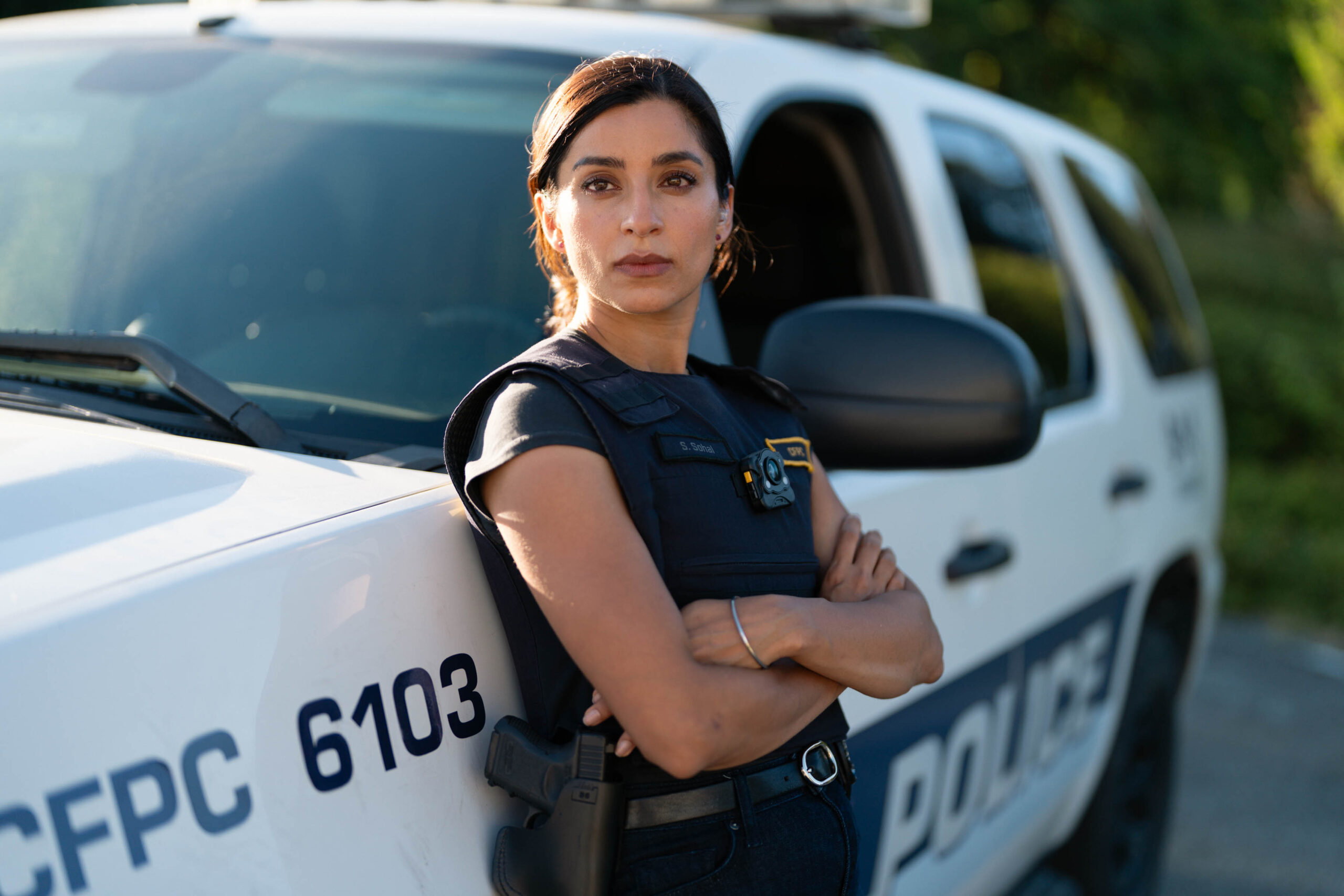
In Allegiance Season 2, Sabrina Sohal (played by Supinder Wraich) was determined to put her badge down for good. While working at the CFPC, the police officer came to realize that she not only had to fight for justice in the streets of Surrey, BC, but also within her own police department.
With the reveal that Assistant Commissioner Oliver Campbell (Vincent Gale) was responsible for framing her father, Sabrina is distrustful of the system. Taking matters into her own hands, the main character goes public with what she knows and holds Campbell accountable for his actions.
At the start of Season 3, premiering on January 7, the protagonist finds her way back to the police force. Not because she’s regained faith in the powers that be, but because of her willingness to serve her hometown community and be there for her partner Zak Kalaini (Samer Salem). For someone who has been constantly torn between where her loyalties lie, Sabrina’s challenge this season is to learn how to be a team player as well as trust her backup.
CBC Gem’s high-stakes procedural offers a nuanced look at policing and politics, often questioning what it means to be fair when enacting justice. In advance of the series return, Wraich spoke to SheDoesTheCity about Sabrina’s mindset in Season 3 as well as hinted at the gripping cases the police officer will take on. The actress also shared more about the mental health support Allegiance’s cast and crew received on set as well as her long-term partnership with series creator Anar Ali.
You’ve been able to play Sabrina for three seasons now. What has the experience been like and how special is it to stay in character for a longer period of time?
I’ve been very lucky that I’ve gotten to live with Sabrina for three seasons and it’s also been interesting because each season she’s had such a distinctive arc. I think Season 1, it was about her kind of being a fish out of water, and figuring out what the CFPC was, and how she belonged there. Then in Season 2, she was a bit of a lone wolf and trying to get things done despite the CFPC and the people that she worked with. In Season 3, there’s a really beautiful arc where she turns towards the people that she works with, her colleagues, her family, and her friends. With each season, I’ve learned something from Sabrina in my personal life, so she’s been a wonderful partner to me.
At the end of Season 2, Sabrina is determined to put her badge down, no longer wanting to work for Oliver Campbell after what he did to her father. In Season 3, where is the character’s mind at?
When Sabrina puts that badge down, there’s an assuredness to her actions. She knows what she wants and what she doesn’t want. I think the beauty of the show is that we really live in the gray. And so of course, when we come back for Season 3, Sabrina is not coming back because of what the job means to her anymore. She’s coming back for her partner. It’s really beautiful to see that relationship develop between Zak and Sabrina, and between Samer and myself as we get to know each other more as actors. The season really takes both of us to difficult places.
What’s interesting about procedurals is that you can always up the stakes. How do you feel about the cases in Season 3?
I think that there’s a real propulsion to the cases this season. There’s a ticking time bomb. There’s a necessity for them to be solved fast. It’s a little bit different, because of the relationship that Sabrina has to her force now and because of the viewpoint that Zak brings. The writers have done such a great job, because there’s such a breadth of stories that we bring to life that would happen across Canada or happen in Surrey, and bring that to viewers’ attention. To see these two individuals navigate how they’re going to confront each case, episode by episode, is really interesting to watch.
I read that there are therapists on set depending on the episode and how heavy the subject matter is. How helpful was it to have that kind of support on set?
In Season 2, depending on certain episodes, we had a therapist on set, and in Season 3, it was the same. Whether you use the resources made available to you or not, just knowing that you’re held and that there is a space for whatever comes up just helps the work go a little bit deeper. It doesn’t feel like you’re tight and holding it by yourself. It feels like everybody is there holding it with you.
I also have to commend one of our showrunners, Penny [Gummerson], and director Madison Thomas, because when they shoot their episodes, particularly if the subject matter is around the Indigenous community, we also have elders come to set. Not only are there therapists, but you can go talk to an elder and you can go do a smudging. We usually do a smudging in the morning, so it feels like we’re not just inhabiting the story for the purpose of pushing it out into the world but as a team we are really living our way through these stories for ourselves as well. I find it so healing.
Before Allegiance, you created and starred in a CBC Gem series called The 410. Do you ever see yourself writing an episode of Allegiance, or maybe writing another on-screen project?
Thank you for bringing up The 410. It was a project that was really near and dear to my heart, to my community, to my family. I love writing. I think that there’s something about the process of writing that feels slow and contemplative and the process of making a TV show doesn’t feel the same way, because we have schedules and deadlines. When I was writing The 410, there wasn’t a Season 2. It was just something that I wanted to write for myself, and I took my time with it. If I could do it in that way, I would love to write an episode of Allegiance.
I think for me as a writer that is still a bit new to the craft, I like to take my time. I like to dig my teeth in. I like to do my research. I would really have to be invested in the subject matter before I take that on again, because it’s all so lonely. The thing I love about being an actor is you get to do it with other people. I think in order to write a project, I would have to be prepared to be by myself with it for a while, and so I’m still looking for what that is.
View this post on Instagram
Lastly, you and showrunner Anar Ali have been close for years. How has it been working with her on a show for so long, especially since she wrote this part for you?
Oh, what a joy it’s been to work with Anar. It just feels so safe. In terms of Anar creating this show for me, it’s funny because I didn’t know it until I got the part. She’s good at keeping secrets, I guess. But it’s been really wonderful to work with her and just know that she’s only a phone call away. We have these on-screen partnerships, and the one that I have with Anar is a really beautiful one that’s off-screen that most people don’t get to see, but it breathes so much history into how I create this character and how I move in this world, because she’s just an endless well of knowledge, and I can constantly go to her and say, why this and why that? You know, ask those questions that come up that truly only the creator of the show knows, because she built this entire world. How lucky am I that I get to have access to that person three seasons in.
This interview has been edited for length and clarity.
Allegiance Season 3 premieres tonight at 9 p.m. ET on CBC and CBC Gem.
 Follow Us On Instagram