




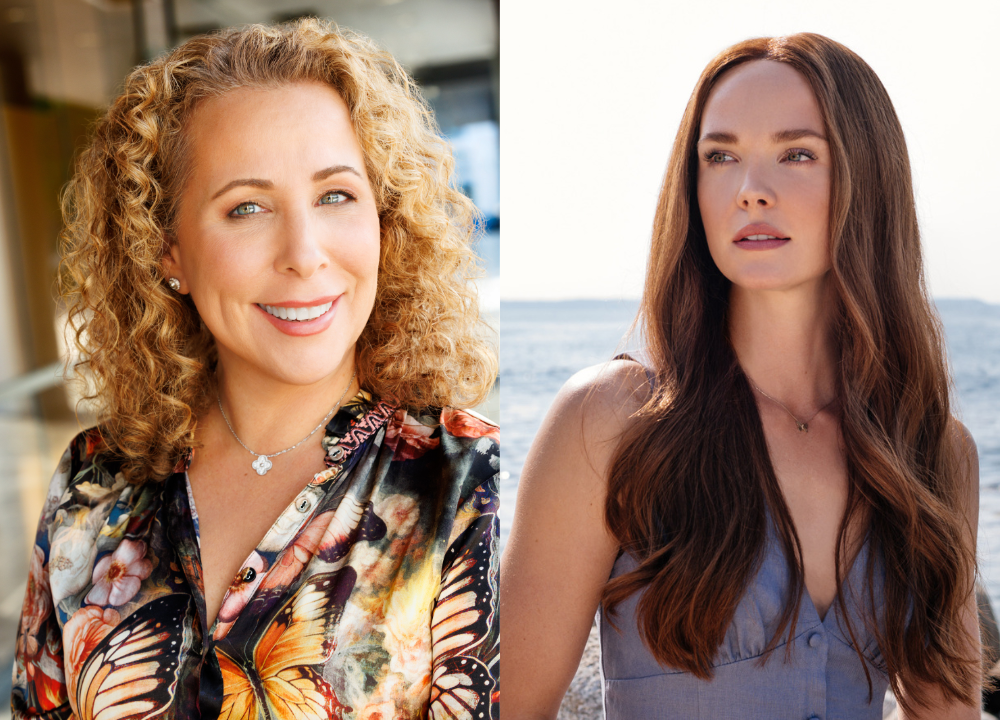
Season 3 of Sullivan’s Crossing ended with one of Roma Roth’s signature cliffhangers. After renewing her commitment to Cal, Maggie’s ex Liam makes a sudden, unexpected appearance, threatening to disrupt her plans. Season 4 of the hit show is airing now, and creator, showrunner, and executive producer Roma Roth is promising viewers another dramatic ride full of ups and downs for the beloved characters of the Nova Scotia-based series.
In addition to Sullivan’s Crossing, Roth is the architect behind Virgin River, and the upcoming series Thunder Point, all of which are based on Robyn Carr’s bestselling books. Roth is known for crafting emotionally resonant, binge-worthy romantic dramas—shows with massive global reach. Virgin River is one of the most-streamed series of the decade, while Sullivan’s Crossing was ranked as the #1 scripted series in Canada across multiple seasons, was CTV’s most-watched drama series and the CW’s most-watched show in the U.S. Through her company Reel World Management, Roth has also distributed, financed and/or produced over 50 television movies.
As the new season of Sullivan’s Crossing unfolds, we asked Roth some questions about bringing Robyn Carr’s books to the screen, reaching a global audience with a series set in Canada, and what makes a good plot twist.
You’ve adapted two of Robyn Carr’s book series, and now you’re working on a third. What first drew you to her books and made you think about bringing these stories to the screen?
Her books really resonate with a very wide audience. It’s not a niche audience. A global audience. And so when you’re trying to find a book series to adapt, you want to find something that really resonates with as wide of an audience as possible. She also had a master’s thesis written about her books and how they really connect with an audience emotionally. In addition to that, her books were on the HarperCollins Top 200 Books of All Time. Hitchhiker’s Guide to the Galaxy, The Thorn Birds, and The Bible were three of the other ones. She really connected, not just in the North American audience, but also globally.
You’ve proven that romance shows can be hugely successful, but some people can still be a little dismissive towards this genre. What do you say when you encounter those kinds of sentiments?
If you go back in time to the Nora Ephron feature films, romance was a big genre, way back when. Then somebody decided that it wasn’t trendy anymore. I think that if you look at any hit television show or feature film, it’s going to emotionally resonate with people, and generally, there’s a romance storyline somewhere in there as well. There’s kind of this misunderstanding of the romance genre as a whole. It has a dedicated fan following as deep as the Marvel universe. I think people have a misconception, and I’m glad that we’re showing that they’re wrong.

With Sullivan’s Crossing, you were stepping into a world that already had a passionate, built-in fan base. How does that influence your approach as a showrunner?
It’s kind of like a double-edged sword. You want to stay as true to the books as possible. But on the other hand, although the readers think that they want exactly what they read in the book, they would already know what’s happening, so that wouldn’t be very entertaining. When you’re reading as a fan of books, you already visualize the characters and the world from your worldview and perspective, and we can never replicate that, so we have to make our own choices in order to adapt.
You’re known for your dramatic twists and cliffhangers. What makes a good twist in a TV series?
Not being able to anticipate where the storyline is going. It’s hard when I’m watching television, I’m like, oh, it’s going to go here, it’s going to go there. I call it setting up the table, then pulling the tablecloth out. You want to create a show that people want to tune into the next episode, albeit if they’re they’re digesting it on traditional broadcast television or on streaming. You want a show that has that, we used to call it a water cooler show, where people would stand around at the office and talk about it. That’s the angle that we go for.
I know it was important to you that Sullivan’s Crossing was set in and filmed in Canada. How does it feel to see that vision realized, and have a Canadian-based show reach a global audience?
It’s very rewarding and gratifying. I mean, we had big shoes to fill. Virgin River had already reached such incredible heights. So this time, I wanted to try and repeat the success, but with a show that was set in Canada, because Virgin River we set in Northern California, despite the fact that it was shot in Vancouver. At that time, people felt that you couldn’t have shows set in Canada, that it wouldn’t resonate globally. But then when I saw Squid Game, it was all in Korean and set in Korea. I decided that we could do this. And one of the gratifying parts of it is that Nova Scotia has seen a huge influx of tourists from all over the world. So it’s helped the economy, not just from the standpoint of bringing a recurring show that’s coming back season upon season, but it’s also really bolstered the tourist trade in Nova Scotia as well.

What do you love most about creating for the medium of television?
They say the medium is the message, and one of the only ways you can really connect with a global community is through television. That’s what I really love about the television medium. We’re airing not just on traditional broadcast, but also on streaming, which allows us to reach an enormous audience, and luckily, the show resonates with a very large global audience and fan base. So it’s nice to acknowledge and understand that we have an influence and we have a responsibility in our programming to send a positive message.
With these shows on streaming, they have the potential to live on for many years. What do you hope your series are remembered for?
Hope. Giving people a glimmer of light in the dark time. I’d like to be able to see my grandkids watching the show on streaming one day, that it’s a show that will have legs to live on. I’ve been very careful with the music, to ensure that the instruments we are using are organic and won’t feel dated, and that the storylines will resonate and keep resonating with audiences over time.
You’re also in development on Thunder Point. What can you tell us about the show? What would fans of Sullivan’s Crossing or Virgin River like about it?
We have a male protagonist this time, as opposed to a female protagonist, and it has an additional storyline with a mystery throughline. So it’s moving the romance genre into a little bit of a different direction now. We’ve done a great job with the two shows that had the female protagonist, but now it’s nice to see romance from a different perspective.
Sullivan’s Crossing Season 4 is airing weekly on Sundays on CTV, and streams the next day on Crave.
 Follow Us On Instagram