


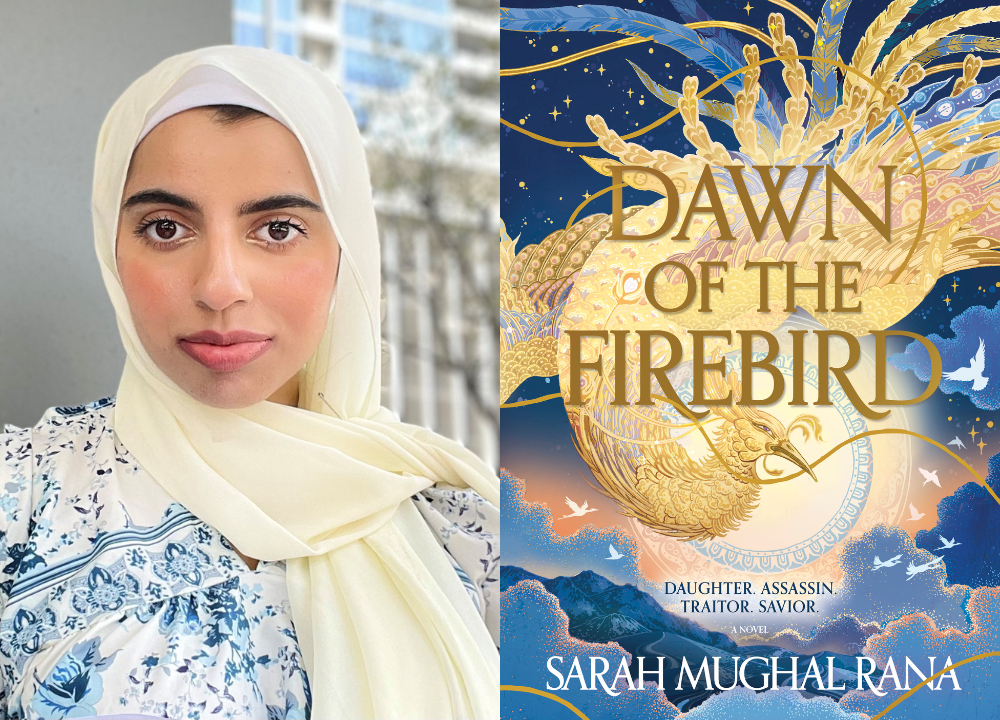
Canadian author Sarah Mughal Rana’s Dawn of the Firebird is a sweeping fantasy epic following Khamilla Zahr-zad, whose life has been built on a foundation of violence and vengeance. Every home she’s ever known has been destroyed by war, and when her clansmen are assassinated by a rival empire, Khamilla knows her heavenly magic of nur is a weapon her enemies would welcome. So she hides her identity and joins the enemy’s army school, full of jinn, magic, and martial arts, risking everything, so she can avenge her clan, topple her adversaries, and reclaim her throne.
Sarah recently graduated from the University of Oxford, studying at the intersection of economic policy and human rights. Beyond the page, Sarah co-hosts the On The Write Track podcast, where she spills the tea with bestselling authors. Also known for the YA title Hope Ablaze, Dawn of the Firebird is her debut fantasy trilogy for adults.
We had the chance to read an early copy of Dawn of the Firebird, and were thrilled at the opportunity to interview Sarah.
SheDoesTheCity: First of all, congratulations on your recent graduation from Oxford University! It’s incredible that as a first-generation student, you have been co-hosting a podcast, and published two novels, one of which has already been optioned as a TV series.What has been your biggest “pinch me” moment of your career so far?
Sarah Mughal Rana: Nothing beats the moment when I found out that Dawn of the Firebird got a publishing deal. I had a lot of hopelessness about this story, and I did not think anyone would understand the characters, and I did not think it was a commercial book. But knowing that Khamilla’s story was embraced by my editor and my publishing team, and that they put everything into this book…they believed in Khamilla and her story of grief, oppression, and resisting the people who’ve always taken her down… nothing beats that moment.
SDTC: Do you have any advice for any emerging writers out there who have been inspired by you and your success?
Sarah: I have two pieces of advice. Firstly: Do not write to cater to a specific market or trend, because writing is an ever-changing landscape, where people’s ideas will adapt based on cultural phenomena, huge milestones, global affairs. There are so many factors out of your control, but the one thing you’ll be able to control is your craft, and your ability to write, improve, and finish a story.
Secondly: As writers you often feel that the world is against you, that your own mind is against you, that your own craft is against you. But… it’s your love and joy for the genre, the book, the story, and its characters [that’s important]. No one else will be a bigger advocate for your characters than yourself.
SDTC: This is a book that’s very much about imperialism, war, and their impacts on people. What drew you to writing about these concepts?
Sarah: I think we live in a very dark, cruel world, that shows that no matter how many mistakes we made in the past, we are always doomed to repeat them. I really think that we’re overstimulated and bombarded with information, and stories of the people around us, but we reduce them to statistics. What’s so fundamentally human about us is that we remember the human stories and are able to stop reducing them to statistics.
That’s Khamilla’s story. I knew this was my opportunity to create a new world, and humanize Khamilla, no matter how bad she becomes. Her arc is about discovering how to be human, how to feel, and how to process grief and trauma. That’s a permission she has to give herself in the story, and that is something that victims of war don’t get.
View this post on Instagram
SDTC: Khamilla is full of rage and vengeance, which makes her a complicated, and even flawed heroine. In an era where readers publicly support women’s rights AND wrongs, why do you think readers are so drawn to messy and complex women protagonists?
Sarah: As women, we go through so much, and at the same time, we have to be strong for the others in our lives. We have to hide our physical pain, and we somehow bear it all. I always think women are the most complex people in the world. So, I wanted to show Khamilla embodying that. She is someone who goes through physical, mental, emotional pain. She is severely troubled, and struggling to cope, doing so in very unique ways… and that is deeply human. When we say supporting women’s rights and wrongs, I don’t think that’s a choice, I think that makes us human.
SDTC: Can you talk a bit about the world-building for this book – what inspirations did you draw from, and what was the process like to build this world of jinn and magic?
Sarah: The world of Dawn of the Firebird had a lot of inspirations. For the actual world, I was tired of seeing stories that take Christian allegories and whitewash them…and as a Muslim, I knew these were stories we also have. One of the stories that always fascinated me was the prophet Nuh (or Noah), and the story of the flood. It was one of the first stories I grew up reading. I also learnt that every single culture in recorded history has a flood story, and [that] is something that really unites us over so many cultures and time periods, so why not write it? I wanted to write about this society recovering from a massive flood that took part of the continent, so that’s where the world was born from.
The magic system was inspired by my love of anime, especially Jujutsu Kaisen, Naruto, and Full Metal Alchemist… I wanted super smart characters that were prodigies, but then very emotionally not intelligent. And what do you do with super smart characters with low emotional intelligence? They’re going to do horrible things to each other. So the magic system was born for my love of the anime aesthetic, and my traditional martial arts background. I was inspired by my love of all of these weird things, meshed together. They always say “write what you love”… I wrote what I loved.
View this post on Instagram
SDTC: I love the relationship dynamics between your characters — there are some unforgettable secondary characters, including a cast of adorable and mischievous children. Can you talk a bit about the role of family and friendship in this story?
Sarah: I think Khamilla’s story is one of coming to terms with grief and love and, as someone who doesn’t understand love, how she copes with that. And this is love of all forms: family love, maternal love, love of siblings, and friends – both from her, and [towards her]. There is toxic, poisonous, and abusive love, but also some really beautiful types of love.
And even the most cold-hearted person, like Khamilla, can’t resist cute children. I really wanted to humanize children in such a bleak setting. Because one thing you’ll always see in my writing is that I will tackle heavy themes, but I will also put in as much humour as is appropriate, and they were my comedic relief, and the softer moments that gave reprieve from the darkness. I also wanted to show that some of the biggest victims of war are children. You lose your innocence, the same way Khamilla did.
SDTC: What are you hoping your readers get out of reading Dawn of the Firebird?
Sarah: I am hoping that [this book] challenges the ways that they [think about] identity, nation making, victims of war, and themes of violence. The goal of Khamilla’s story isn’t to condone any action, or to encourage a certain theme. The only goal of her story is to make you think in the shoes of someone who has to survive in a world of violence, where her entire life has been oppression. So, instead of judging her actions, I challenge people to understand why she does what she does, because I think that will help [them] understand why the world is the way it is.
SDTC: What have you been reading lately? What books inspire you?
Sarah: The River She Became by Emily Varga (which comes out next summer). It’s inspired by stolen artifacts, and the lore of the fey of Northern Pakistan, and is about a young brown girl who wants to resist colonialism. [Varga’s] debut was For She Is Wrath, which was an amazing revenge book — so if you’re reading Dawn of the Firebird, and you want another revenge story, For She Is Wrath is my number one recommendation.
SDTC: Finally, I know Dawn of the Firebird just came out, but what’s next for you?
Sarah: I’m writing the sequel to Dawn of the Firebird! Without spoilers, book one was about breaking away from bonds, and book two is about exploring these bonds, while still fighting for freedom. It’s about reconciling her bonds with her mission. It’s much more a war epic than a magic school. I’m trying to borrow some of the things people liked in book one, while still being true to the vision of book two. There will also be plenty of naughty children!
This interview has been edited for length and clarity.
–
Ameema Saeed (@ameemabackwards) is a storyteller, a Capricorn, an avid bookworm, and a curator of very specific playlists and customized book recommendations. She’s a book reviewer, a Sensitivity Reader, a book buyer at Indigo Books & Music, and the Books Editor for She Does the City, where she writes and curates bookish content, and book recommendations. She enjoys bad puns, good food, dancing, and talking about feelings. She writes about books, big feelings, unruly bodies, and her lived experiences, and hopes to write your next favourite book one day. When she’s not reading books, she likes to talk about books (especially diverse books, and books by diverse authors) on her bookstagram: @ReadWithMeemz
 Follow Us On Instagram