



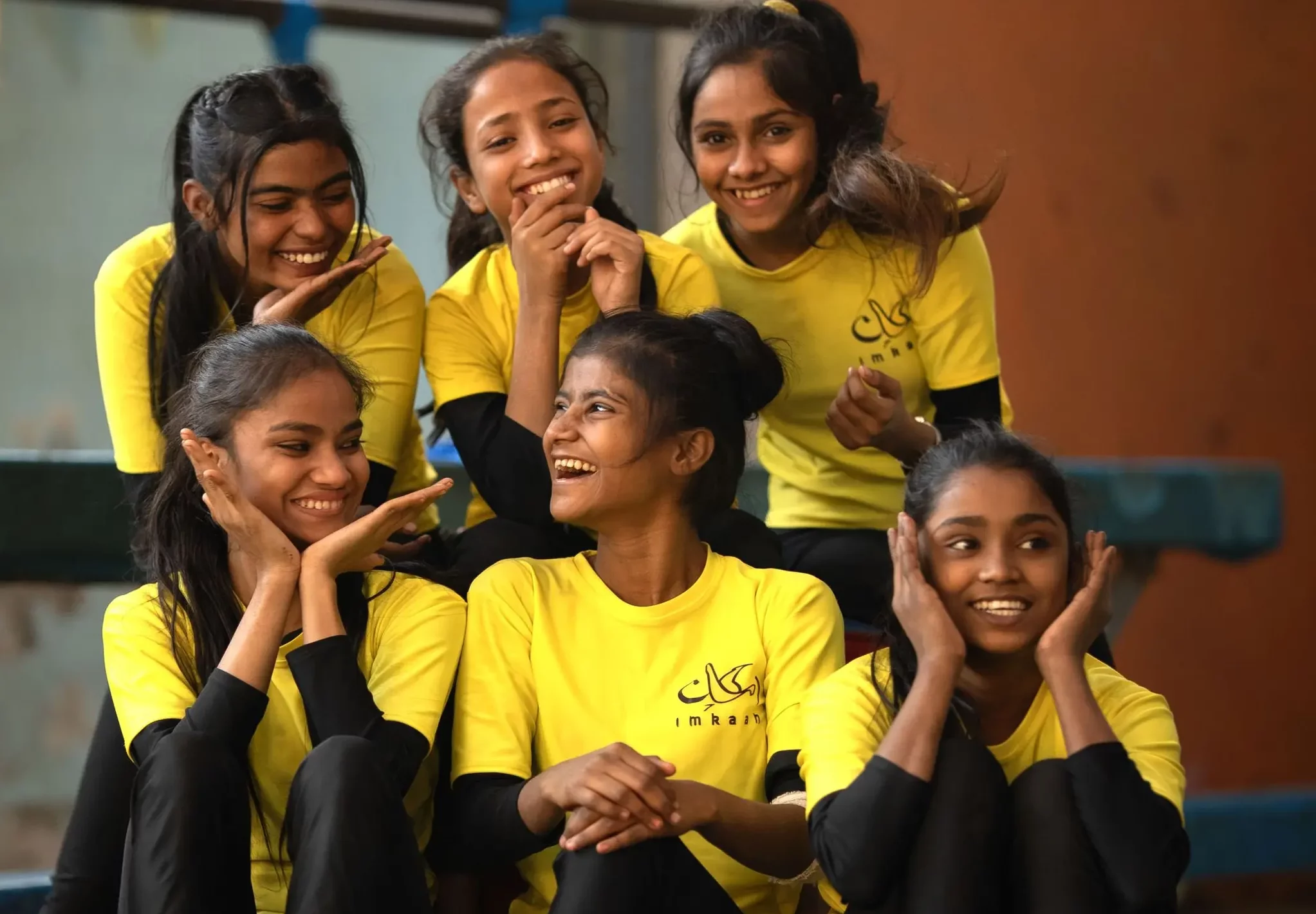
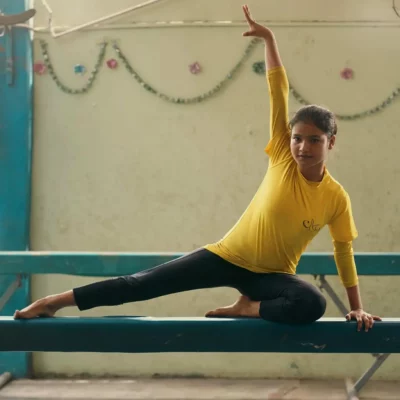
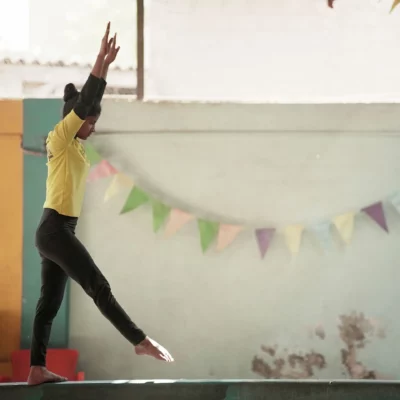
In a small gym in Pakistan’s Machar Colony, a team of girls in yellow uniforms practice cartwheels, handsprings, and beam walks. While the world outside those walls might believe that girls shouldn’t do gymnastics, or any athletics, this space is their sanctuary—a place where they are free to play, move, and deepen their budding passion for the sport.
In her latest documentary, The Gymnasts of Fisherman Colony, Emmy and Peabody Award-winning filmmaker and investigative journalist Habiba Nosheen shines a light on three of these girls—girls who are daring to dream. Sonia, Kiran, and Anwara possess rebellious spirits, quietly defying the deeply rooted societal expectations placed upon them by continuing to train in gymnastics, go to competitions, and come home with stacks of medals and trophies.
In our conversation, Nosheen tells SheDoesTheCity about the making of The Gymnasts of Fisherman Colony, receiving support from Malala Yousafzai and Mariska Hargitay, and conveying a new, joyful image of brown girls on screen.
How did you first find out about this gymnastics team, and how did the documentary come to be?
10 years ago, I adopted my daughter from Pakistan, and Tahera, who you meet in the documentary, was our adoption lawyer. A few years ago, I started noticing her posts about these girls doing gymnastics. I could also tell from the pictures that they weren’t girls from elite communities. There was a grittiness to the photos, and that provoked more questions on my part. So I reached out to her, found out about this program and the fact that she had been working with the stateless community for over 10 years by that point, trying to give them access to education and sport. I just was so moved by that because when I saw these girls, my first thought was, Wow, they’re so brave.” I wish I was like that at that age while living in Pakistan. Because I don’t know if I would have had the guts to do what they do and push their way through community criticism and family criticism to continue to do this sport. I was like, these are some badass girls, and I want to get to know them.
Why were Sonia, Kiran, and Anwara the three girls you wanted to follow? What stood out to you about them?
We wanted to make sure the families were on board because we knew we weren’t just going on this journey with the girls. We were going on this journey with the families, and we wanted to make sure that the film did not in any way make their life more difficult. We also liked that two of them were sisters. You could tell from our initial conversation that they were kind of competitive with each other, and we thought that brought an interesting emotional mix to the picture. We had within these girls also a feistiness that really came through. We were drawn to them because they were very vibrant and vocal, outgoing, really owned their thoughts. We wanted the world to see a side of Pakistani girls that they often don’t see.
In the film, it’s explained that in Pakistan many people believe that girls shouldn’t do gymnastics, or any sports. Did you get a sense of that mindset while you were filming?
To be honest, it’s not just Pakistan that this is limited to. I am from a Pakistani family, grew up in Toronto, and my brother was a star athlete. He had three sisters, and there was this unsaid rule within our Pakistani family that sports aren’t for girls. Nobody came out and said this to us, but it was just something I had internalized along the way. One of the reasons I wanted to make this film was because I want my Pakistani daughter to not grow up internalizing the message that I internalized—that sports aren’t for girls who look like us. I saw and heard lots of stories about families pulling their daughters out due to pressure. I just thought, wow, nothing was handed to these girls. They worked to gain space, to take up space that was not for them. And I was inspired by that.
The film tells an important story, but you also capture lots of joyful moments amongst the girls. Why was it important for you to include these moments of girlhood and play?
I’ve been doing this for about 20 years, and a couple of years ago, I took a look at my own body of work, and I felt a bit critical of it because I felt that I hadn’t made anything that portrayed the joy in the lives of women who are brown. This project was in part inspired by challenging my own body of work and saying, “Wait a minute!” I’ve told all these stories that I’m really proud of, but when you look at them as a whole, you’re missing this part. You’re missing that brown girls have fun. You’re missing their humanity in this way that I haven’t been able to capture, and so I felt that I owed it to our community.
Some big names are attached to the project as Executive Producers, like Malala and Mariska Hargitay. What was it like to have their support on the project?
I mean, it’s just a magical dream—when you’re making this, nobody goes in thinking that they’re gonna have Malala and Mariska Hargitay come on as executive producers. The fact that these amazing, incredible women from all walks of life wanted to come on to lend their voice, to lend their name and credibility to this project— I mean, my God, it means so much to us. I think it’s because there’s a universality of the story that they were moved by. They all see something in these girls that they think is worth elevating, which is their humanity and their conviction, and demanding space. I think girls everywhere do need to demand more space, and we need to provide them the platform to do that.
What do you hope viewers take away from The Gymnasts of Fisherman Colony?
When I talk to Tahera, she really advocates for the fact that it is incredibly important to imagine a world where every child has the right to play, and let’s create spaces for them where their playing is at the center of how we teach them to grow. And we often just don’t prioritize that. We just don’t, especially for children who are from marginalized communities. I want people to see the film to recognize that joy is part of the lives of brown girls. Despite the fact that we never see it, we never see it on TV, we never see it in cinema, we never see it in popular culture. Brown girls have fun. I’m a bit tired of the restricted kinds of images of brown women that exist in the media and I want us to think about being more expansive in showing the humanity of brown women and girls.
‘The Gymnasts of Fisherman Colony’ is available to stream now on CBC Gem.
 Follow Us On Instagram