


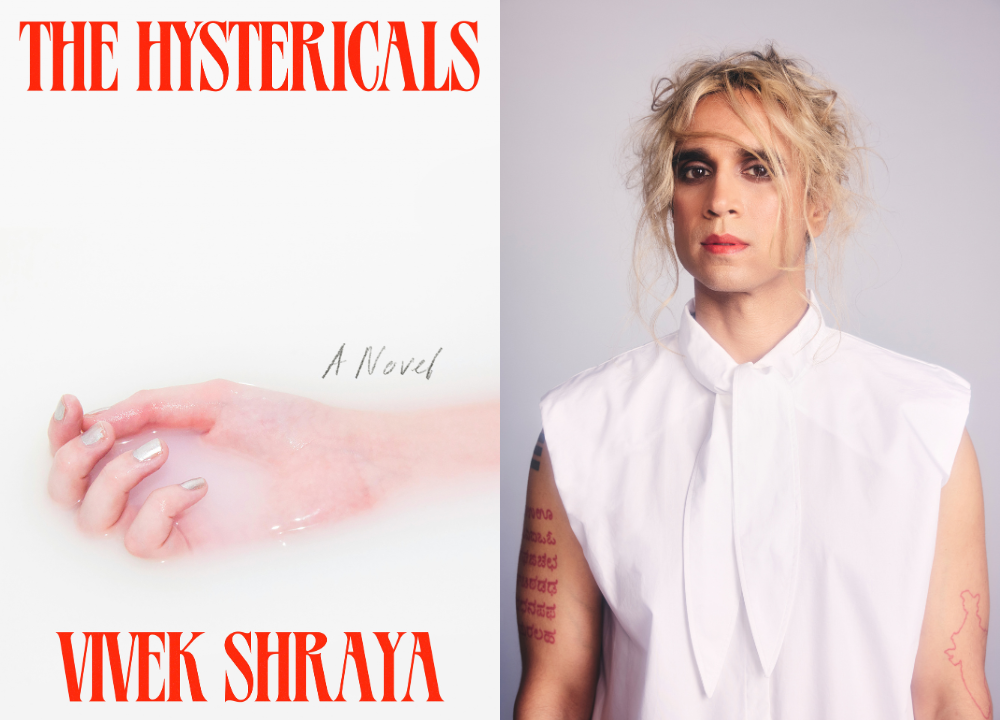
Described as “The Handmaid’s Tale for the post- #MeToo era”, Vivek Shraya’s latest is a chilling work of speculative fiction set in a world that has stripped women of their rights. The Hystericals follows sisters Sarah and Kennedy Munroe, who find themselves at the centre of a movement that could liberate women…or destroy them all.
When Sarah is sexually assaulted at university and her attacker walks free, she makes a devastating choice, publicly ending her life in defiance of the ruling misogynist regime. Her death soon ignites a radical movement of women following in her footsteps, taking up “Sarah’s Call” in an extreme act of protest.
As the death count racks up, the regime reclassifies all women as “hystericals”—their very existence criminalized overnight. Struggling with grief, guilt, and anger, Kennedy must grapple with her sister’s legacy, and decide whether to surrender or survive.
Shraya is known for her bold, barrier-breaking work across artistic disciplines, from her best-selling book I’m Afraid of Men to the CBC Gem Original Series How to Fail as a Popstar. The Hystericals has already received praise from the likes of Catherine Hernandez, Scaachi Koul, and Kai Cheng Thom.
With women’s rights under attack around the world, and the 10th anniversary of #MeToo quickly approaching, the themes of The Hystericals are hitting close to home. We’re pleased to be bringing you an excerpt from the book, hitting the shelves on September 29.
Content Warning: The Hystericals contains depictions of suicide and self-harm, sexual assault, gender-based violence, and state oppression of women and marginalized groups.
“Sarah, wait for me!” I yelled, slamming the door to the dean’s office behind me.
Memory is an elusive bugger, isn’t he? A bit like consent . . .
I ran down the empty hallway, unable to erase the image of the dean shaking his bald head. His snide tone.
Questions about the credibility of your complaint have been raised . . .
My squeaking sneakers echoed. I couldn’t see Sarah anywhere. She had to be running too.
To be perfectly frank, your allegations are far more consistent with your own disconcerting pattern of rule breaking and attention seeking . . .
The dean’s words grew louder in my mind until I realized with a start: There was a group of male students nearby, their voices booming. I looked around for somewhere to hide.
I swung open the nearest door and then closed it behind me. Scanning the tiny custodial closet, it occurred to me that I had accidentally created my own trap. If those men found me in here, I wouldn’t be able to get away. I switched off the light and covered my mouth as the voices got louder.
“I’m telling you. Three hundred push-ups a day or die,” one of the men said.
I tried to stay calm, but my pulse accelerated thinking about what had happened to Sarah, right here on this campus—only to be told that she was lying.
As someone who once worked closely with your mother—and has a great deal of respect for your father’s commitment to factualism—I would be remiss not to add that I think you ought to seriously reflect on how you might repair the damage you’ve done to the Munroe name. It’s a shame parents can’t expel their daughters, ha.
Stay alert, Kennedy, I told myself.
I waited until long after the men’s voices had dissipated before re-emerging.
“Sarah? You in there?” I whispered into the women’s washroom. She had pointed out this morning that it was one of the only remaining women’s washrooms on the entire campus. No response.
I darted to the side doors of the building and pushed through. It took a few seconds for my eyes to adjust to the smog outside, but there she was, sitting on the steps. Back erect, she looked statuesque, like the kind of monument to a notable woman she often wished existed on campus.
I went to sit on the step beneath her, but she noticed me first. With an exhale, she turned human again and stood up immediately.
“Oh fuck. Kennedy . . . ”
“Sarah, I’m so mad—”
“I know, I’m so sorry for abandoning you. My brain kind of evaporated, and I needed some air.”
“No, no. I’m mad about what just happened in there. The dean didn’t even make eye contact with you.”
“Men with power usually refuse to face the truth.”
“Dad’s not like that,” I responded automatically.
“Yeah, that’s why he’s here right now.”
I hated when she used sarcasm against me—a tactic Mom accused her of using whenever she had a weak argument—but this time I had to agree with my sister. It shouldn’t have been just the two of us in that meeting. At the very least, Dad should have driven us to campus out of love and concern for Sarah. For both of us. Even if we were used to walking with caution.
After EP5, gas had become unaffordable, so our state government severely restricted the number of women allowed to drive and randomly voided many of the licences held by women as a rationing effort. Public transit was also cut.
“No, you’re right. I’m sorry,” I said, feeling like the naive baby sister that I worried Sarah thought I was. Even though Jenni and I were both seventeen, sometimes I wondered if Sarah would have preferred having my best friend as her sister, someone who was just as intellectually curious and fired up as she was. The last time the three of us were together at Century Park, both of them had railed against the new Guardian Tax.
“I thought it was to make sure single older women are being taken care of?” I had said.
“No, they’re just penalizing financially independent women,” Sarah responded.
“Yeah, the same women who’ve been pushing back against our state’s misogynist marriage coercion tactics,” Jenni added.
“Oh,” I replied. I hadn’t ever imagined a future where I’d be alone, so I needed a moment to consider the implications of what they had shared. But they both squinted at me, waiting for me to say more, and I sensed they were disappointed when I didn’t.
Just like Sarah was squinting at me now. Suddenly, for the first time in years, she held my hand.
“Don’t be sorry. Don’t ever be sorry,” she said. “Stay close.”
Sarah had never outgrown the fear she’d had since ep1 of infecting me, and the feeling of her fingers against mine made me want to cry. I squeezed her hand back, and we turned toward home.
“You know, that’s actually the root of the problem. Women have always been the ones to say sorry. Apologizing for taking up space, for speaking up, for not being perfect all the fucking time. And this has only made us look culpable for what men have done to us,” she said. “This has to stop.” She paused, studied me again, and asked, “How do we make it stop?”
Sarah had a habit of making passionate statements and asking rhetorical questions like this in plain conversation, with the kind of conviction of someone speaking to an audience. When Sarah was thirteen, she’d volunteered for Planned Parenthood, and even though pedestrians would zoom by her peers with their clipboards and pink T-shirts, somehow no woman could refuse her when she asked, “Do you have five minutes to talk about how the government is secretly eroding our reproductive rights?” She got this quality from our parents, though I’d never told her that. She would hate hearing it.
“Shit,” she said under her breath, dropping my hand. I followed her gaze and spotted the group of teenage boys ahead, playing soccer with their shirts off.
“Let’s just turn around,” I said.
“There isn’t another way home.” Sarah pulled her hood over her head, and I immediately did the same. “Push your shoulders back. And remember: wide steps. Take up space.”
Excerpted from The Hystericals by Vivek Shraya. Copyright © 2026 Vivek Shraya. Published by McClelland & Stewart, a division of Penguin Random House Canada Limited. Reproduced by arrangement with the Publisher. All rights reserved.
 Follow Us On Instagram