




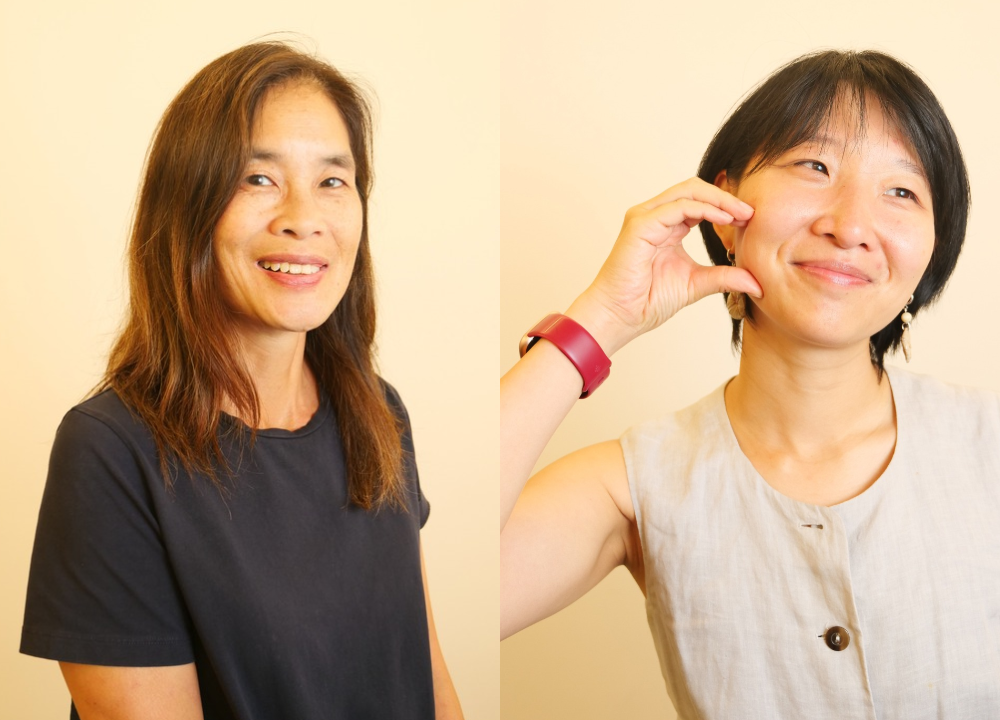
As the Toronto Reel Asian International Film Festival celebrates its 30th anniversary, the organization will undergo a big transition. Deanna Wong, the long-time Executive Director, recently announced that she will be stepping down from her role. But she’s leaving Reel Asian in good hands—Associate Director Kelly Lui is set to succeed her.
Wong will step down as ED after the upcoming edition of the festival, running from November 11-29. With Ashley Duong’s Ba’s Book set to open the festival, TIFF favourite Sunburn, and a panel featuring Vivian Lin, showrunner of Crew Girl, the 30th anniversary is set to deliver.
With this milestone edition of the festival just around the corner, we wanted to bring together Wong and Lui to share stories, advice, and reflections on their time at Reel Asian—outgoing ED to incoming ED.
Deanna Wong: So, Kelly, this is going to be my last festival, and you, as the associate director, are going to come into this role. What excites you about coming into this position?
Kelly Lui: I always say that I kind of grew up with the film festival. It was my first official job and the longest job I’ve been in. I’ve been so privileged to work in an organization where there has been a history of women executive directors and to follow that line. And to have this time with you, Deanna in particular, to be mentored by you and to share this leadership role together, I think that’s something that’s so rare in the industry.
DW: That’s so nice to hear. I feel really lucky to be able to leave the organization in your capable hands. Having been in the festival world and the not-for-profit arts world for so long, I’ve seen how hard it is for organizations to transition. I could see how much you love this organization, and you’d been taking a leadership role for quite a while…so I feel really lucky.
KL: I get to work with you every day in a very closely shared office now. It’s been so amazing, but there’s a lot I still want to learn from you. Is there one piece of advice you can give me now?
DW: One thing I would say is it can be a really lonely job, and that’s why this past year working with you has been really great. So my advice to you would be, you have so many great ideas, but you need to be able to delegate. You can’t do everything yourself. It’s impossible. You will burn out. You have to just look around. We have so many talented people working for us.
View this post on Instagram
KL: Reel Asian, when I started in 2018, that was my first foray into the film world. I never came from a film background. Deanna, you’ve been in this position in the early 2000s. Even before that, you’ve been so involved with the film industry and the community here. During our time together we have seen changes in the industry, and just curious to hear on your end, what have been some of these important changes that have been made?
DW: I think that early on, the subject matter of a lot of the North American films that we screened were often about identity and identity politics—how we as Asians fit into the mainstream society. It was very much about the hyphenation—how do we as Asian-Canadians try to fit in? How are we assimilated or how are we different from Americans who are more of a melting pot and we are like a cultural mosaic? Now I even say those words, and it’s so antiquated, and doesn’t really apply anymore. And the biggest change I see has been that first of all, there’s so many there’s so many outlets and streaming platforms. It used to be that the only place that you could see Asian stories like ours, about people that look and sound like us in Canada and Toronto, was at a festival like ours. But now you could just watch it any time you want. YouTube, I think, is responsible for a lot of the stories from our community being normalized or out there. Our kids can see themselves readily. Whereas for me, it was always a big revelation whenever I saw somebody who looked like me on TV who wasn’t speaking English with an accent, or who wasn’t a delivery driver or a restaurant owner or a laundromat owner. So that’s the biggest change I would say.
KL: There’s been so much conversation around what is a Canadian story, what is a Canadian film. We have filmmakers like Mayumi Yoshida, and her recent film Akashi—I know you’ve been following Mayumi’s journey.
DW: Yeah, she was a strong advocate. It used to be that to be classified as a Canadian film and to qualify for funding from Telefilm, you had to have your film in English, French, or an Indigenous language, and she had to really fight for that. Her story was about a Japanese-Canadian young woman who goes to Japan for her grandmother’s funeral. So of course, the majority of the language in that film was Japanese. But that’s such a Canadian story. It’s an immigrant story, and it just seemed so arbitrary and just wrong for that not to be considered a Canadian story. So that’s a big change.
KL: Yeah, it’s been huge.
DW: So what are you excited about seeing [at the festival] this year, Kelly?
KL: Oh my goodness! So actually, growing up, I didn’t watch TV a lot. And funny enough, when I start working at a film festival, I start binge-watching a lot of TV series and watching things that I didn’t watch growing up. In particular, the TV Writing Program—we will be doing that live table read. So I’m super excited to see some of those scenes acted live or read live by amazing local actors, and of course have the event hosted by Vivian Lin. I am a huge YA fan, and anyone who loves Crew Girl, Vivian was the showrunner of that series on Netflix. So I’m really excited to fangirl for Vivian. How about you, Deanna? What are you looking forward to?
DW: This is our 30th anniversary, so I am super excited about the fact that we have an archive project. One main part of it is that we’re setting up an internet cafe. I’m so nostalgic, and I love that they’ve been collecting people’s memories and small snippets from past festivals. They’ve talked to everyone from former filmmakers to former board staff, advisory, and things have been mailed into the office. It’s going to be put together and displayed in our office throughout the festival.
KL: And I’m super excited for the trading cards that they’ve commissioned. Philip Ocampo, who’s an amazing local artist, basically took reference from the 30 years of Reel Asian posters and redesigned them into trading cards. So as a collector myself, I’m trying to practice a lot of restraint not to put all my money into purchasing very affordable packets of trading cards because yeah, you want to collect them all. And there will be a trading post at the internet cafe. Speaking of 30 years of Reel Asian, do you have any favourite memories of the festival?
DW: Back in the early days, we really didn’t have a budget to do much more than fly our filmmakers over here. And I remember that we had a really exciting guest, Christine Choy, who was an Oscar-nominated director of the film Who Killed Vincent Chin?. We had an arrangement with a big house at Spadina Station. Like a BnB before Airbnb, just really cute, quaint rooms. But when she arrived and we presented her with her accommodation, she immediately checked herself out and found a hotel on Bloor. That was a lesson learned! We thought we were doing her a favour because everybody else, we would try to find billets for them. We would put a call out to our community of board members and say, “Does anybody have a room to put up a visiting filmmaker?” We would matchmake them, and it’s a great way for filmmakers to get to know our community.
KL: Some of our billet hosts are actually icons.
DW: People who have had films at our festival, but have also just been supportive for all these years.
KL: For myself, I grew up as a so-called jock. I grew up doing competitive sports. So when I worked in my first year at Reel Asian, I was a programming coordinator. There was one producer who, we got along really quickly. We were talking for months leading up to the festival. And at the festival, she just mentioned that her son was a swimmer, and we realized that I actually coached him when he was very young. Actually, both of her sons. So I had actually known her from a past life without realizing now that we both are in film. So I think the festival is such an amazing place for all these connections. I think there are so many things that have flourished through Reel Asian, whether it’s finding the love of your life, or the creative partner that you’re gonna keep collaborating with, or the friends you wanna go and watch films with.
DW: Yeah, that happened a lot over the years. One thing you reminded me of was one of the first festivals I attended before I was the Executive Director, I ran into Olivia Chow, our current mayor, recently re-elected. She was a city councillor back then, so I knew who she was. And it just so happened that Reel Asian had programmed a short documentary made by her 14-year-old nephew. So she was just there to watch. That must have been 2004 or 2003, something like that. Our relationship with the mayor goes back a long way.
KL: I want to see that short film.
DW: I think it was it was it was about hamburgers. I think he was taste-testing hamburgers.
KL: Oh my god, I need to watch it.
View this post on Instagram
DW: What is the first thing you want to do when you take over as executive director?
KL: I’ve recently been inspired by ImagineNATIVE, our neighbours in The Commons in The 401. For a long time they’ve recognized how their staff aren’t just arts workers; they’re also artists or have their own creative pursuits. So they’ve been able to carve out time for their staff as part of the working culture to let them have time set aside to do their own work, and then to share back. So I think similarly at Reel Asian, we have so many amazing staff who are so talented in the work, but are also very talented artists. So I think something like that, modelling that, would be really great.
KL: Deanna, we ask everyone, all guest artists, all incoming staff, this one question. If you had to pick one, what would you pick: rice, noodles, potatoes, or bread?
DW: I almost have to clarify this. Do you mean to eat for the rest of your life, or if I was confronted with that at a restaurant, what would I pick? Because actually, those are two different questions.
KL: I feel like many of us interpret it very differently. For me, it’s like allegiance. I’m gonna say it first because…noodles all the way. I love noodles. Who doesn’t love noodles?
DW: I pick rice. I love all carbs, I didn’t have to think very long though. I really love rice.
KL: Noodles.
DW: That’s fine, we can agree to disagree! You’re taking over the organization now. You want to make it a rice-free zone.
KL: No, all carbs are welcome! Deanna, I feel like I learned a lot about you in this.
DW: Thank you for having us do this! This is really nice to actually sit down and talk about these things.
The Toronto Reel Asian International Film Festival is running from November 11-21 in person, and November 16-29 online.
This interview has been edited for length and clarity.
 Follow Us On Instagram